Showing posts with label Commemorative. Show all posts

Wednesday, March 20, 2019

Panel #26: Wellington & Vittoria

"Wellington
Vittoria"
Panel #26

During the long war between France and Britain that lasted from 1799-1815 Arthur Wellesley, then Viscount Wellington, defeated Napoleon's armies at a battle in Spain near the city of Vitoria in 1813. England celebrated with this panel (spelled by the English Vittoria) which we can date to 1813.

The first Duke of Wellington
by George Dawe

The panel style, an octagonal design with a dark background and a triple frame with blue ovals pinning the corners, is similar to other English panels, leading us to conclude that the panel type was produced in the early teens. The frame echoes Georgian silver and other decorative arts.

We have five quilts with this panel, all from Great Britain. Americans would be a very unlikely market for this commemorative honoring one of their English enemies during the War of 1812.

The corners feature different images: the thistle symbolizing Scotland,
the rose England and the shamrock Ireland.

Knowing the date when the panel was produced does not give us much information about when the quilts using it were made. True, we have an early date. A quilt with the Wellington/Vittoria panel couldn't have been produced before 1813, but the ending date is up in the air.

The lag time between the panel's production and quilts using it
is sometimes surprising.

Chapman Coverlet, date-inscribed 1829
Collection of the Victoria & Albert Museum
106" x 98"

A linen label under the panel is embroidered with the names
John and Elisabeth Chapman, September 19, 1829.

http://collections.vam.ac.uk/item/O166891/bed-cover-and-unknown/

The museum caption indicates this piece evolved over nearly a century. The papers behind the curved patchwork blocks date from the 1790s, recycled pages from ledger and copy books and receipts from Rochester in Kent.

The poem on the label is an epitaph by William Grove about a "lucky husband" published in the late 1790s. 

The final striped border is fabric from the 1890s.
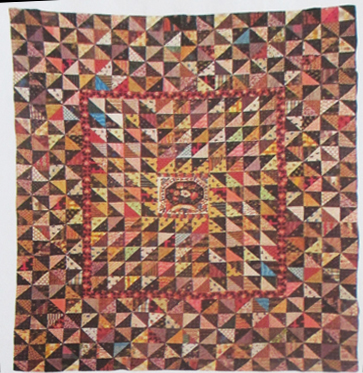

The book Quilt Treasures of Great Britain showed a quilt with the Wellington panel in a field of patchwork, dated in the quilting 1834, attributed to a dressmaker in North Devon named Jemima Puddicombe.

In her 1965 book Patchwork Quilts Averil Colby showed this quilt attributed to Aunt Lucy Gane, telling us, "It is probable that this work was done soon after the printing of the commemorative panel in 1813." But looking at the two quilts above makes us realize we cannot be so sure. The double four patch borders seem later. A close look at the other fabrics would narrow the date from "After 1813."

Auctioned at Tennant's Auctions
This frame quilt with four Wellington panels also looks
to date to well "after 1813."


The emphasis on block designs looks far later than the early 19th century.

On the other hand, British quilt historian Mary Jenkins showed this early quilt on her blog Little Welsh Quilts after finding it pictured at auction at the Penrith Farmers' Auction in Cumbria, northern England.

The fabric and the overall style, to say nothing of the appliqued scenes,
look very much in keeping with a date of "Early 19th century, after 1813."

The single panel looks to be stitched into some kind of a flap. Mary noted the piece was in poor condition, perhaps due to deterioration in the appliqued figures, which look to be "dressed pictures," fabric over paper---an unstable situation.

The panel here is untrimmed and gives us information about the
repeat---apparently, a floral stripe separated the panels.

UPDATE:
The British Quilt Guild Heritage Project's book Quilt Treasures of Great Britain in their chapter on fabric alerts us to a second Wellington chintz.

"Two medallions were printed to commemorate the victories of the Duke of Wellington. They were identical except for the name of the battle concerned. One was for his victory in 1813 over the French at Vittora in Spain, and the second was for his famous victory of 1815 at Waterloo."
Jemima Puddicombe's 1834 quilt above has the second medallion/panel at Halifax but the photo is too small to tell us anymore.

What Can We Learn from Panel #26?

The Wellington panel gives us a good example of the folly in dating quilts to the years when the panels were likely produced "1810-1820". We have a 21-year lag in the 1834 Jemima Puddicombe quilt and examination of the fabrics in a couple of the undated quilts above might reveal a longer lag. 

Why the lag? Our first thought was that people and families kept the panels for years until someone found a use for them.

Stalls at the Wrexham Market Fair, 
where much fabric was sold for centuries

But our second thought relates to commerce. Perhaps some shopkeeper, stall keeper or wholesaler found a supply of fabric from the teens and offered it at a nice discount twenty years later.

See Mary Jenkins's post on the pictorial quilt here:

Below panels with similar frames:


Sunday, October 7, 2018

Panel #21: Princess Charlotte of Wales

British quilt top from a Christie's Auction with panel #21 in the center .

Panel #21, Princess Charlotte of Wales/
Prince Leopold of Saxe-Coburg marriage commemorative panel, 1816
A lovely quilt, very British in it's appliqued hearts and pieced frames, celebrating a future Queen of England, the only heir of King George IV.

The final border is a stripe popular on both sides of the Atlantic,
often paired with the fruit panel #5.

 Royal Wedding, May, 1816

Top sold at Tennant's Auction

Another cheerful quilt full of  hearts and hope for the future of the couple.


Sampler by Tirzah Gibbs, 1829, Bonham's Auctions

"Princess Charlotte
Died November the 5th,1817
Aged 22
Hope is Fled"


1817 was a bad year for English celebrities. Jane Austen died in July; Charlotte in November, a day after giving birth to a baby who died too. Great Britain was shocked. There were no other heirs and no hope her parents would ever have a civil encounter in the same room again much less another royal baby.

In 1923 MacIver Percival showed a trimmed panel in his The Chintz Book. In the inner border: "Princess Charlotte of Wales Married to Leopold Prince of Saxe Cobourg May 2, 1816"

The Victoria & Albert Museum has yardage with the name of the printer on the tax stamp: John Lowe and Co. Furniture Printers, Shepley Hall.
http://collections.vam.ac.uk/item/O164887/panel-unknown/

The Castle Museum in York has this chintz applique
in its collection. Four Charlotte panels surround an oval floral (Panel #15)

Like other panels commemorating British current events
we can assume that the panel was not printed for export.

See the George III Jubilee panel at this post:

However, there are a couple of style characteristics in the Castle Museum coverlet that make me wonder if it is American. One is the lack of piecework in the borders. Another is the abundance of palm trees and birds. It's not that English quiltmakers didn't use palm trees and peacocks but they didn't use them in the same way. (A digression.)

Most of the Charlotte quilts look very British and most of them are in England today.

England's Beamish Open Air Museum has a nine patch with the panel in the center.

Medallion below from the Binney collection is now in the New England Quilt Museum, the only known Charlotte quilt in the U.S. today. 

Princess Charlotte Commemorative
New England Quilt Museum
Gift of the Binney Family

Parts of Panel #5 form a ring around the birds...

The same birds as in the Castle Museum's top.

A Second Charlotte Panel

In Emma Jane Worboise's 1877 novel The Grey House at Endlestone she crafted a well-observed, cobwebby scene. Hilda awoke in a strange bed...

"the hangings were of faded chintz, the counterpane was a wonderful device of many-coloured octahedrons with a choice centre-piece, displaying the washed-out features of the Princess Charlotte, surrounded by the dates---almost illegible---of her Royal Highness's birth and marriage."

I thought this might be a description of the octagon panel above but then I realized there is another 
Princess Charlotte textile.

With a portrait --- rather washed out and with her birth and death dates.

British frame quilt auctioned at Wooley & Wallis showrooms.

The panel is a monochrome toile, something we are NOT
indexing here but it is too cool to ignore.

The Metropolitan Museum and the Victorian & Albert each
have a panel. As you can see in the quilt it's large, 19" x 26".
The portrait with a mourning wreath was copied from a print...

Copied from a painting

Portrait of Princess Charlotte of Wales
1816. Collection of the Brighton Museum

And one more Princess Charlotte memorial:

The New England Quilt Museum also has a nicely
arranged hexagon top by Englishwoman Catharine Tebay 
through 1816 and 1817.


Attention to detail throughout the patchwork...

Including this typeset label along the edge

and a piece she must have inserted after finishing
 the top, mourning the death of the Princess.

Monument to Princess Charlotte at Windsor Castle 
by M.C. Wyatt, finished in 1824

What Can We Learn From Panel #21?

The Prince(ess) of Wales's symbol of three feathers and motto
"I serve" in German

These polychrome framed panels marking public events seem to have been popular with British textile printers in the teens, beginning with the George III Jubilee panel about 1809, continuing through Wellington's Victory at the Battle of Vittoria in 1813 and Charlotte's wedding in 1816. Links to events easily date them and we can assume that many of the other popular panels in similar designs were printed from about 1810 to 1820.

American side chair with nail head trim, 1795
Collection of the Winterthur Museum

 We also assume the panels were printed for furnishings and this Charlotte panel supports that view with its dotted border that looks much like nail heads.


Chair with nail head trim, 1794–99 attributed to
Samuel McIntire, Salem, Massachusetts
The Metropolitan Museum of Art

Read Anita Loscalzo's “Commemoration and Grief: Two Coverlets and the Death of Charlotte Augusta, Princess of Wales” in the British Quilt Studies Group's 2012 publication, Quilt Studies 13. 

See pictures of the panels at these links: