Showing posts with label Octagon. Show all posts

Wednesday, March 20, 2019

Panel #26: Wellington & Vittoria

"Wellington
Vittoria"
Panel #26

During the long war between France and Britain that lasted from 1799-1815 Arthur Wellesley, then Viscount Wellington, defeated Napoleon's armies at a battle in Spain near the city of Vitoria in 1813. England celebrated with this panel (spelled by the English Vittoria) which we can date to 1813.

The first Duke of Wellington
by George Dawe

The panel style, an octagonal design with a dark background and a triple frame with blue ovals pinning the corners, is similar to other English panels, leading us to conclude that the panel type was produced in the early teens. The frame echoes Georgian silver and other decorative arts.

We have five quilts with this panel, all from Great Britain. Americans would be a very unlikely market for this commemorative honoring one of their English enemies during the War of 1812.

The corners feature different images: the thistle symbolizing Scotland,
the rose England and the shamrock Ireland.

Knowing the date when the panel was produced does not give us much information about when the quilts using it were made. True, we have an early date. A quilt with the Wellington/Vittoria panel couldn't have been produced before 1813, but the ending date is up in the air.

The lag time between the panel's production and quilts using it
is sometimes surprising.

Chapman Coverlet, date-inscribed 1829
Collection of the Victoria & Albert Museum
106" x 98"

A linen label under the panel is embroidered with the names
John and Elisabeth Chapman, September 19, 1829.

http://collections.vam.ac.uk/item/O166891/bed-cover-and-unknown/

The museum caption indicates this piece evolved over nearly a century. The papers behind the curved patchwork blocks date from the 1790s, recycled pages from ledger and copy books and receipts from Rochester in Kent.

The poem on the label is an epitaph by William Grove about a "lucky husband" published in the late 1790s. 

The final striped border is fabric from the 1890s.
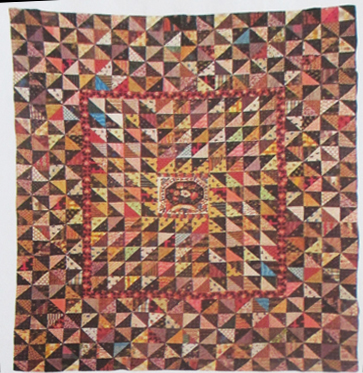

The book Quilt Treasures of Great Britain showed a quilt with the Wellington panel in a field of patchwork, dated in the quilting 1834, attributed to a dressmaker in North Devon named Jemima Puddicombe.

In her 1965 book Patchwork Quilts Averil Colby showed this quilt attributed to Aunt Lucy Gane, telling us, "It is probable that this work was done soon after the printing of the commemorative panel in 1813." But looking at the two quilts above makes us realize we cannot be so sure. The double four patch borders seem later. A close look at the other fabrics would narrow the date from "After 1813."

Auctioned at Tennant's Auctions
This frame quilt with four Wellington panels also looks
to date to well "after 1813."


The emphasis on block designs looks far later than the early 19th century.

On the other hand, British quilt historian Mary Jenkins showed this early quilt on her blog Little Welsh Quilts after finding it pictured at auction at the Penrith Farmers' Auction in Cumbria, northern England.

The fabric and the overall style, to say nothing of the appliqued scenes,
look very much in keeping with a date of "Early 19th century, after 1813."

The single panel looks to be stitched into some kind of a flap. Mary noted the piece was in poor condition, perhaps due to deterioration in the appliqued figures, which look to be "dressed pictures," fabric over paper---an unstable situation.

The panel here is untrimmed and gives us information about the
repeat---apparently, a floral stripe separated the panels.

UPDATE:
The British Quilt Guild Heritage Project's book Quilt Treasures of Great Britain in their chapter on fabric alerts us to a second Wellington chintz.

"Two medallions were printed to commemorate the victories of the Duke of Wellington. They were identical except for the name of the battle concerned. One was for his victory in 1813 over the French at Vittora in Spain, and the second was for his famous victory of 1815 at Waterloo."
Jemima Puddicombe's 1834 quilt above has the second medallion/panel at Halifax but the photo is too small to tell us anymore.

What Can We Learn from Panel #26?

The Wellington panel gives us a good example of the folly in dating quilts to the years when the panels were likely produced "1810-1820". We have a 21-year lag in the 1834 Jemima Puddicombe quilt and examination of the fabrics in a couple of the undated quilts above might reveal a longer lag. 

Why the lag? Our first thought was that people and families kept the panels for years until someone found a use for them.

Stalls at the Wrexham Market Fair, 
where much fabric was sold for centuries

But our second thought relates to commerce. Perhaps some shopkeeper, stall keeper or wholesaler found a supply of fabric from the teens and offered it at a nice discount twenty years later.

See Mary Jenkins's post on the pictorial quilt here:

Below panels with similar frames:


Monday, February 25, 2019

Panel #40: Ranunculus in an Octagon & Dated Quilts

Panel # 40 is another octagonal panel with a triple border
similar to a Georgian silver platter with a form of the "Leaf & Lozenge" border
as Kay Triplett mentioned in the last post's comments.

The central flower: an orange ranunculus with two red poppies in a supporting role.

An orange ranunculus is quite eye catching.

Similar floral imagery on an 18th-century plate from the
Sèvres Porcelain Manufactory in France. Collection of the Art Institute of Chicago

The pottery at Sèvres used a particular type of clay that took glazes well with vivid results. Very collectible pottery from this French factory, Europe's most fashionable porcelain source in the last half of the 18th century, gives us an idea of the long-lasting fashions for their classical, baroque and rococo imagery. 

Porcelain table top from Sèvres

Sèvres created luxury items for the French aristocracy before and after the Revolution.
A printed cotton panel gave one a similar look for a more democratic price.


We have photos of only two quilts with panel #40, the first from Elizabeth Hake's 1937 book 
English Quilting Old and New - With Notes on Its West Country Tradition: Five panels in the center area.

Four panels are in the corners of Elisabeth Capes's quilt in 
KayTriplett's Collection

Capes's central, larger panel is #1, found often in the U.S. & the U.K.

Panel #40 is one of the rare panels with only two quilts in our database---both English. Perhaps if we did some research in English museums we'd find more. As collectors Lori and Kay Triplett write in their catalog of Chintz Quilts from the Poos Collection:
"The octagon pre-printed medallions are a bit more challenging to track down....It seems likely that the panels may have been printed as a series, or perhaps competing calico manufacturers copied successful designs."
We noted style characteristics in the last post---the work of one artist at one mill or several knockoffs?

See another octagonal pattern with jewel-like lozenges pinning the border:

Kay has written a comment here, reiterating the information on page 94 of her catalog.
"This quilt is inscribed 'This quilt was designed by Elizabeth Capes of CASTOR and finished by her Jan'y 1810, in the 63rd year of her age.' Also in cross stitch is SC 1809, which is probably her daughter Elizabeth Sabrah Capes....As far as I know, this is the oldest dated chintz panel quilt."
Castor is about 75 miles north of London, far from the West Country that Elizabeth Hakes explored in the 1930s.

What Can We Learn From This Panel?


The 1810 Elisabeth Capes quilt is the earliest date-inscribed panel quilt we have in our photo files. Dated quilts are rather rare but you can see a trend in the seven British quilts in our database. British quiltmakers appear to have made framed medallion quilts with panels between 1810 and 1835. All seven are attributed to England although they may not be there today.


Another way of looking at the dated sample.


We think this data is reliable enough to give us a range as to when to date a British frame quilt with
a panel---1810-1835. There is no evidence the style developed before 1800, although many captions in older books give that date.

Detail of the 1816 Princess Charlotte panel

The early-19th-century dates are corroborated with information on British textile history.  Panels were printed on cotton, which was not abundant in 18th-century England, and they were printed with woodblocks, technology replaced by cylinder printing in the 1820s and '30s. Panels were an inexpensive decorating commodity, popular in the years before Queen Victoria's era.

Panels and porcelain

Porcelain-fronted desk
Read more about Sèvres decorative arts at the Metropolitan Museum Shop's site.
The only Sèvres I can afford to collect is their enameled tin reproductions.

Monday, February 11, 2019

Panel #39: Blue Ribbon (& #38)

Panel #39 in an appliqued bedcover dated 1812 with initials E.I.,
Gawthorpe Hall Textiles Collection,
Lancashire, England

One of the earliest date-inscribed uses of multicolor chintz panels
in a quilt made in Great Britain. 
The quilt is 98” x 111" and includes two panels.


The panel is octagonal, a bouquet of flowers tied with a blue ribbon and framed in a triple border of diamonds and leaves with blue lozenge shapes in the angles. 

The border might have been drawn from a Georgian silver platter.


It's a pretty design, wood-block printed in full chintz style. Were the browns always brown? Hard to say. Could have been purple.

We have five quilts with the panel, all British frame quilts with a central focus and a sixth one that is probably British.

Collection of Cindy Vermilion Hamilton
Probably British

Cindy's bedcover features panel #1 in the center, bordered with birds and then half and
quarters of Panel #39


The blue bowknot at the bottom of the bouquet is a visual clue that the center panel
in this quilt in the collection of the Victoria & Albert Museum is #39.
Little is known about this bedcover. 

Four of the octagonal panels rotate around the center bird panel in 
this piece auctioned by Kerry Taylor in London.

The long-necked bird panel (# 11) is usually seen in American quilts, but this quilt
by style and location is obviously British.

Below: Panel 39 rotates around a center focus panel (# ) at the top half of this medallion. The quilt was documented in the Prince Edward Island project and featured in their book by Sherrie Davidson. The story passed on with it is that it was stitched for an 1810 wedding that never took place.


Prince Edward Island is in Canada, north of Maine and Nova Scotia---British America.

The family date is consistent with the date on the quilt at the top of the page here.

Another British Empire quilt with Panel #39

Spread attributed to Mary Moxey of Williamtown, New South Wales, 
Australia. National Trust (NSW) Collection

The cross-stitch inscription on the left:
"Mary Moxey. 1818"
On the right:
"Emma Tremlett Born Decr 16th 1837"

Did Mary Moxey make this piece in 1818 in England and dedicate it to young Emma years later in Australia?


The frame is related to the Wellington/Vittoria panel celebrating the Duke of Wellington's 1813 British victory in Spain during the Napoleonic Wars. Note the dark center on the Wellington panel.
We don't often see the dark-centered designs used in American quilts. And this victory panel would have been quite unpopular with Americans in 1813 who were at war with the British.
What Can We Learn From Panel #39? 

Center of a hexagon quilt in the collection of the International
Quilt Study Center and Museum #1997-007-0341 with Panel #22

As we continue to sort out the panels and the quilts we see a difference in taste in the U.S. and the U.K. Americans tended to use the white ground panels. Britons also used the white panels but we have found more dark ground designs in Great Britain.

Source?

It's not a fool-proof clue to location, but when we see a dark
ground panel we guess the quilt is from Great Britain.

Kerry Taylor auction in England, 2012

Another regional clue is the panel's frame style. Like Panel #39 panel #38 in the crib quilt above is framed with what looks like the edge of a silver platter. Circular beads imitate embossed metal work---an elegant look. 


The blue ovals might be jewels.

We only have two quilts with the oval Panel #38.

The other piece with Panel #38 is attributed to Marianna Lloyd Button,
thought to have been made in England and brought to Tasmania
in 1833...

...shown in Making the Australian Quilt

Here's a panel with both style characteristics---dark ground and embossed frame style--- 
in a British bedcover in the collection of the International
Quilt Study Center and Museum.

IQSC #2007-014-0001 is thought to have been made in Allendale, England.

More examples of  colored-ground panels and the platter-like frames later.


UPDATE:
My calendar from the Metropolitan Museum shows this French Sevres Drop Front Desk from the 18th century. Certainly gives us insight as to where blue ribbons and roses come from.