Sunday, October 7, 2018

Panel #21: Princess Charlotte of Wales

British quilt top from a Christie's Auction with panel #21 in the center .

Panel #21, Princess Charlotte of Wales/
Prince Leopold of Saxe-Coburg marriage commemorative panel, 1816
A lovely quilt, very British in it's appliqued hearts and pieced frames, celebrating a future Queen of England, the only heir of King George IV.

The final border is a stripe popular on both sides of the Atlantic,
often paired with the fruit panel #5.

 Royal Wedding, May, 1816

Top sold at Tennant's Auction

Another cheerful quilt full of  hearts and hope for the future of the couple.


Sampler by Tirzah Gibbs, 1829, Bonham's Auctions

"Princess Charlotte
Died November the 5th,1817
Aged 22
Hope is Fled"


1817 was a bad year for English celebrities. Jane Austen died in July; Charlotte in November, a day after giving birth to a baby who died too. Great Britain was shocked. There were no other heirs and no hope her parents would ever have a civil encounter in the same room again much less another royal baby.

In 1923 MacIver Percival showed a trimmed panel in his The Chintz Book. In the inner border: "Princess Charlotte of Wales Married to Leopold Prince of Saxe Cobourg May 2, 1816"

The Victoria & Albert Museum has yardage with the name of the printer on the tax stamp: John Lowe and Co. Furniture Printers, Shepley Hall.
http://collections.vam.ac.uk/item/O164887/panel-unknown/

The Castle Museum in York has this chintz applique
in its collection. Four Charlotte panels surround an oval floral (Panel #15)

Like other panels commemorating British current events
we can assume that the panel was not printed for export.

See the George III Jubilee panel at this post:

However, there are a couple of style characteristics in the Castle Museum coverlet that make me wonder if it is American. One is the lack of piecework in the borders. Another is the abundance of palm trees and birds. It's not that English quiltmakers didn't use palm trees and peacocks but they didn't use them in the same way. (A digression.)

Most of the Charlotte quilts look very British and most of them are in England today.

England's Beamish Open Air Museum has a nine patch with the panel in the center.

Medallion below from the Binney collection is now in the New England Quilt Museum, the only known Charlotte quilt in the U.S. today. 

Princess Charlotte Commemorative
New England Quilt Museum
Gift of the Binney Family

Parts of Panel #5 form a ring around the birds...

The same birds as in the Castle Museum's top.

A Second Charlotte Panel

In Emma Jane Worboise's 1877 novel The Grey House at Endlestone she crafted a well-observed, cobwebby scene. Hilda awoke in a strange bed...

"the hangings were of faded chintz, the counterpane was a wonderful device of many-coloured octahedrons with a choice centre-piece, displaying the washed-out features of the Princess Charlotte, surrounded by the dates---almost illegible---of her Royal Highness's birth and marriage."

I thought this might be a description of the octagon panel above but then I realized there is another 
Princess Charlotte textile.

With a portrait --- rather washed out and with her birth and death dates.

British frame quilt auctioned at Wooley & Wallis showrooms.

The panel is a monochrome toile, something we are NOT
indexing here but it is too cool to ignore.

The Metropolitan Museum and the Victorian & Albert each
have a panel. As you can see in the quilt it's large, 19" x 26".
The portrait with a mourning wreath was copied from a print...

Copied from a painting

Portrait of Princess Charlotte of Wales
1816. Collection of the Brighton Museum

And one more Princess Charlotte memorial:

The New England Quilt Museum also has a nicely
arranged hexagon top by Englishwoman Catharine Tebay 
through 1816 and 1817.


Attention to detail throughout the patchwork...

Including this typeset label along the edge

and a piece she must have inserted after finishing
 the top, mourning the death of the Princess.

Monument to Princess Charlotte at Windsor Castle 
by M.C. Wyatt, finished in 1824

What Can We Learn From Panel #21?

The Prince(ess) of Wales's symbol of three feathers and motto
"I serve" in German

These polychrome framed panels marking public events seem to have been popular with British textile printers in the teens, beginning with the George III Jubilee panel about 1809, continuing through Wellington's Victory at the Battle of Vittoria in 1813 and Charlotte's wedding in 1816. Links to events easily date them and we can assume that many of the other popular panels in similar designs were printed from about 1810 to 1820.

American side chair with nail head trim, 1795
Collection of the Winterthur Museum

 We also assume the panels were printed for furnishings and this Charlotte panel supports that view with its dotted border that looks much like nail heads.


Chair with nail head trim, 1794–99 attributed to
Samuel McIntire, Salem, Massachusetts
The Metropolitan Museum of Art

Read Anita Loscalzo's “Commemoration and Grief: Two Coverlets and the Death of Charlotte Augusta, Princess of Wales” in the British Quilt Studies Group's 2012 publication, Quilt Studies 13. 

See pictures of the panels at these links:

Sunday, September 23, 2018

A Chinese Garden: Panel #35

Panel #35 is one of two in our database with Asian figures on a theme of Chinoiserie, the French name for the decorating craze interpreting Asian arts for the European market. The fashion for Chinese imagery in furniture like Chinese Chippendale coincides with the fashion for panels in the early 19th century and it's likely the panel above was printed in England in the teens or early 1820s, as were most of the panels we've studied.

Panel #29 also features a garden with a pair in Chinese robes.

#35 is more formal with a dark octagonal border
pinned with oval lozenges.
We have five American quilts with this panel and one  two English.

Quilt of many pieces from Patricia Smith's collection

The family story handed down with this quilt is that Captain William H. Torrey from Foxborough, Massachusetts of the 55th Massachusetts Colored Army carried this confiscated quilt north during the Civil War. See a post on the quilt here:
https://civilwarquilts.blogspot.com/2018/08/stolen-quilts-south-carolina-to.html

A trimmed version of the garden scene is framed by dogtooth triangles
and then border after border of squares.

Attributed to a member of the Alexander family of
Charlotte, North Carolina, Collection of the Hezekiah Alexander House, #78.107

Here it plays a supporting role to the larger butterfly panel #19. See a post on that panel here:


International Quilt Study Center & Museum #2007.040.001
Little is known about this piece but we can make some guesses.
Southern, 1830-1850.

Again, the panel frames a larger piece (#2) used as yardage for a border
combined with yardage of Panel # 32.

One gets the feeling that Chinese Chippendale furniture and imagery was rather passe by the time quiltmakers here were using this fabric. It seems to be filler rather than focus.

Crib size top. Collection of Polly Mello.
The maker cut three panels in half to make borders.

The fifth quilt is English from Rosemary Blackett-Ord's
Helbeck Collection.

Although our snapshot is indistinct we can see it as a basic construction alternating strips of Panel 35 with strips of Panel 32 framed by chintz florals. The panels seem to be of the same size and same repeat proportion. 

Number 32 is unusual in that it has butterflies in the corners (more about #32 later). We see the same butterfly in the block below.

Broderie Perse block signed
 Ann Helen(a?) Bender? Clarke, B Island
1849

The sixth quilt is an unfinished album, a collection of 25 blocks at Colonial Williamsburg, donated  in 2002 by the family who believe it to have been intended for Mary B. Clarke of Beech Island, South Carolina before her wedding to David H. Porter in 1855. The blocks are dated 1848, 1849 & 1850.

This seamstress trimmed the frame from Panel #35 and added more flowers and the buttefly over the seam lines. This is the only colorway we have seen of the fabric.

Colonial Williamsburg's catalog describes the "flower garden scene. A Chinese man with a pole is harvesting a pod from a branch. A female figure is seated nearby; there is a basket at her feet. In the center is an urn and perched on top is a parrot that appears to be tethered by the female. Fluttering overhead is a butterfly. The flowers are roses, lotus blossoms and leaves. The colors are reds, greens, blues, whites and browns."


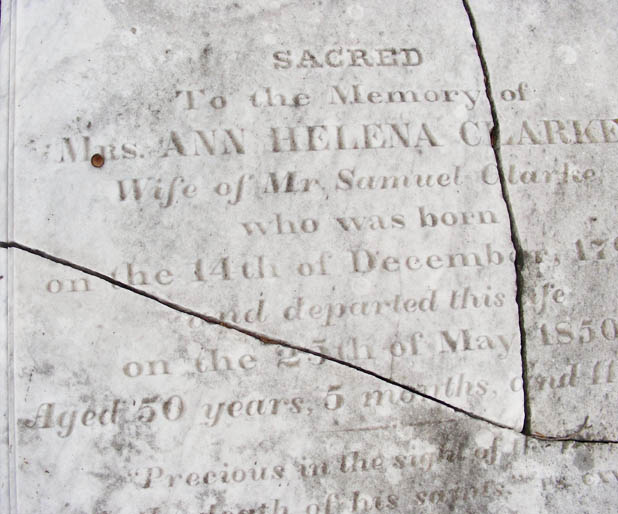
Ann Helena Bender Clarke who signed the block was Mary Clarke Porter's mother, married to Samuel Clarke of Beech Island, which is in Aiken County on the Savannah River near Georgia. Ann died in 1850 at the age of 50, according to her tombstone. Reason enough to leave an album unfinished?

See her grave site:
https://www.findagrave.com/memorial/33286264/ann-helena-clarke

And her block:


UPDATE: Christopher Wilson Tate showed an English frame quilt at the 2018 Houston Quilt Market.
Teri & Kara at the Through the Needle's Eye blog took a good photo.

That makes two British examples.

Reproduction Fabrics did a copy of panel #35 a few years ago
but it's out of print now.

What Can We Learn From Panel #35?

I've outlined the structure of the large quilt at IQSCM.

International Quilt Study Center & Museum #2007.040.001
111" x 107"

The design is nicely proportioned and rather simple: making a good quilt to copy. You'd start with an appliqued center square (Broderie Perse style) composed of a large a central panel, four palm trees, four small birds and two butterflies. How long could that take?


The photo at IQSCM is so good I can see the seam lines around the applique, which
indicate the center panel was cut as an oval and the smaller pieces trimmed pretty closely.

Then four chintz borders of panels and stripes. Of course, obtaining panels and large-scale stripes is the hard part. Certainly, piecing would be easy and take no time at all. Then you could have the top quilted in an allover design of scallops. You'd have a spectacular bedcover with little investment of labor.

On the other hand, I am not going to recommend you copy this quilt from Patricia Smith's collection.
And I am not going to count the pieces. You would really have to love handpiecing (probably piecing over paper) to make this quilt, a long-time project of small squares organized in shaded bands with a chintz stripe border framing a center panel. It looks to be the dedicated work of a seamstress with a lot of scraps---cabbage, maybe, small pieces left over from a dressmaking or clothing business?

We have two very different quilt styles here---the pieced squares a labor of love; the Broderie Perse, perhaps, a labor for money. Looking at many panel quilts we are struck by how simple they are: Borders of chintz strips framing showy centers quilted in an allover design. Below a few very basic constructions.

Collection of the Charleston Museum, Unknown maker. Panel #2.

 All you needed was a good supply of chintz (panel or not), some skillful seamstresses, one woman with a good design sense and a customer base. We bet there was someone in Charleston or Columbia, South Carolina who had all that. Finding such similar quilts in so many antebellum aristocratic families indicates these were luxury goods, not made by plantation owners but purchased in the cities like their silver and porcelain.

Quilt from Woodard & Greenstein's inventory.
Broderie Perse/chintz borders.
Unknown maker, unknown place.

From an eBay auction.
Bluejays and cactus borders
Found in Pennsylvania.