Sheraton Panel (#37)
Sheraton panel: One name for these chintz images that are "printed to shape."
Cherub among the flowers?
It may not have been meant to be a face.
This panel's dark octagonal frame is unusual enough that we've spotted several examples in some fuzzy photos.
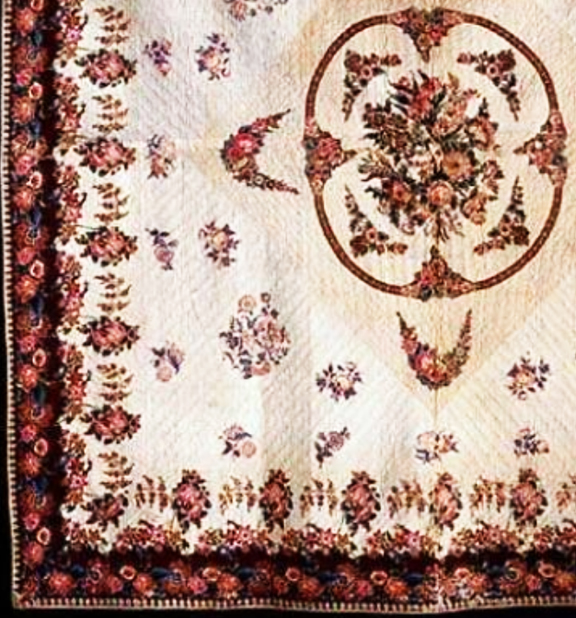
British frame quilt top in Cindy Rennel's collection
It has four panels in the corners. The panel is a square with cut off corners, an octagon, framed by a dark sprigged collar of sorts. In this example the background is white.
We did a post on this English quilt now in Marysville, Kansas from the Huxtable family there. The center panel is an oval with birds (#30) and like the Rennell's example the center is framed with four of panel #37.
Another quilt with corner panels that look to be #37 with
most of the dark frame trimmed.
Bedcover, 1830-1840, Collection of the Victoria & Albert Museum
The central panel here is #5, the fruit basket that was quite popular in the U.S. but not so often seen in the U.K. Cataloging information about the fruit panel:
"The particularly large example at the centre of this bed cover was probably printed in the 1820s or early 1830s, at a time when the surrounding prints would also have been highly fashionable in middle class homes across Britain."
The series of pieced frames and other style characteristics like the border of hexagons indicate that it may be an exception to the rule about that fruit panel being printed for Americans. This may indeed be a British quilt, but Merikay notes the piece was donated to the V&A by American Peggy Westerfield to honor late curator Peter Floud. Westerfield lived in Maine and was a huge textile collector. The cataloging notes say it was purchased from the Ladies's Work Society---but where.
So the quilt's origins are unclear. We'll do more on Panel #5 later.
Back to #37....
Jane Lury has an elaborate frame quilt in her collection
with Panel #37 as the central focus.
Photo from her exhibit in Nantes, France last year.
An Australian quilt, made in Adelaide, dated by
the papers 1830-1831 and in the center....
Pictured in Annette Gero’s Historic Australian Quilts.
Tan or tea-ground colorway for the panel.
This panel isn't large. It may have been designed to fit in a small decorative spot on a chair. We have not yet seen it in a quilt that we firmly believe is American-made.
What Can We Learn from Panel #37?
Sheraton Style
The dark octagonal shape seems well adapted to chair seats and chair backs for Sheraton-style furniture.
Chair from Percival's Old English Furniture
with a small painted detail on the back.
In his 1923 book
Chintz MacIver Percival described panels as "very popular in the Sheraton period, being used for applying to plain material for bed furniture [drapes] and for ornamenting chairs and other seats."

Sheraton period refers to the English furniture style popularized by Thomas Sheraton, who incorporated decorative details from French Louis XVI styles.
French chair in the Louis XVI style, a tour-de-force
of privilege that preceded the 1789 French Revolution.
French card table top with marquetry (inlaid wood) decoration.
One term for these scroll-like decorative shapes is cartouche.
French chair with child and dog in an
octagonal frame. The seat also has a decorative
panel, either embroidered on a canvas (needlepoint)
or a tapestry (woven on a loom).
At the highest level, French kings and English peers could buy chairs embellished with tapestry or embroidered medallions or commission furniture decorated with paint or inlaid marquetry designs. Those with smaller household budgets could ask an upholsterer to include a printed cotton panel for a similar look.
Sheraton's drawings show chairs with decorative inserts.
He modified the over-the-top French look, although you couldn't call this understated.
Percival wrote an earlier book on furniture history in 1920, Old English Furniture and Its Surroundings: From the Restoration to the Regency:
"In some cases, Sheraton suggests the use of prints on silk or satin for the finishing of his furniture. They should, he says, 'be sewed onto the stuffing with borders round them.' They were to be used not only for the stuffed seats and backs, but also for the tablets in the top rails of the open-backed chairs, where they were to be pasted on and surrounded by a small gold bead.
Square decorative image in a Sheraton chair back,
perhaps painted or a textile
"This was, no doubt, a cheap imitation of the more or less well-painted panels used in better class work. Either this treatment was seldom carried out or else it has proved very perishable, for few examples have survived. Even if it were desired to reproduce similar decorations, it would be a most difficult matter as special prints would be required, which are not now obtainable."
Percival sounds relieved.
Chintz chair seat cover from an online auction
Two removable slip covers in Sheraton style
Chair seat cover commissioned by London draper
Richard Ovey. Collection of the Victoria & Albert Museum.
Linda Eaton in the Winterthur Museum's latest catalog
Printed Textiles points out this Sheraton drawing featuring a chintz panel from his appendix. Sheraton wrote:
"The covering of the seat is of printed chintz which may now be had on purpose for chair seats, together with borders to suit them."
In his 1945 book
Old Quilts William Dunton mentioned Percival's use of the word Sheraton in reference to a panel quilt Dunton found in Baltimore, "which was acquired by purchase a generation or two ago." He then deduced:
"As Thomas Sheraton died in 1806, age 55, it seems safe to assume that this print dates from 1800, or shortly before, until such time as we can accurately determine its age."
Dunton is right about Sheraton's death date but his "safe" assumption is illogical. Sheraton never printed fabric. He was a furniture maker and author whose design ideas shaped taste for decades after his death. Dr. Dunton was very observant in describing and categorizing the quilts he saw in Maryland but some of his conclusions as to dates and quilt sources are woefully incorrect. Forget his "Before 1806" time frame.
Read Sheraton's
The cabinet-maker and upholsterer's drawing-book in the 1804 version here:
https://archive.org/details/cabinetmakerupho00sher